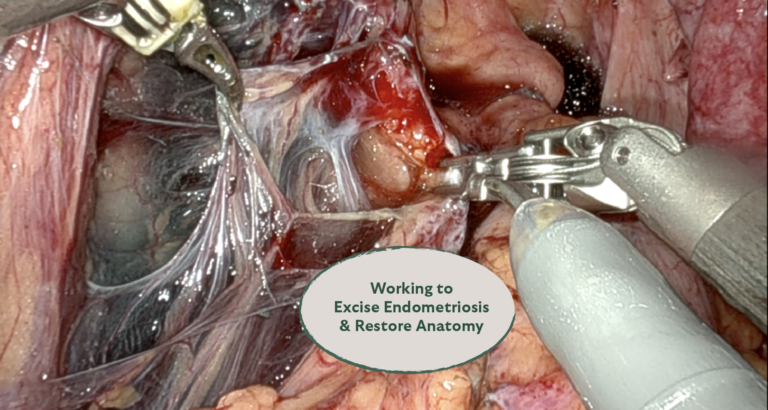
If you’ve been experiencing irregular bleeding, spotting between periods, or heavy menstrual flow—especially during perimenopause or menopause—and your ultrasound shows a suspected growth inside the uterus, you may be dealing with a uterine polyp. Polyps are commonly found in patients who are struggling to conceive. Fortunately, there’s a simple, effective treatment that doesn’t require any incisions: a hysteroscopic polypectomy.
This minimally invasive, outpatient procedure allows your surgeon to directly visualize and remove polyps through the cervix with no abdominal cuts, stitches, or long recovery times. At ESSE Care, we prioritize precision, comfort, and fast recovery in all our hysteroscopic procedures.
What Are Uterine Polyps?
Video: What Are Uterine Polyps?
Uterine polyps (also known as endometrial polyps) are growths that form in the lining of the uterus. They are typically benign and can vary in size from millimeters to several centimeters. Uterine polyps are common in individuals who:
- Are perimenopausal or postmenopausal (roughly ages 40-60, though younger women can get them too)
- Are experiencing fertility issues
- Have abnormal or heavy menstrual bleeding
- Have been diagnosed with thickened endometrial lining on ultrasound
- Have polycystic ovarian syndrome (PCOS)
- Have an elevated body mass index (BMI)
- Have endometriosis
- Have been exposed to high levels of estrogen (e.g., Tamoxifen)
Uterine Polyps vs. Fibroids
Video: Polyps vs. Fibroids
Uterine polyps are different from uterine fibroids. Polyps grow from the lining of the uterus, called the endometrium, while fibroids originate in the muscular layer of the uterine wall, known as the myometrium.
What Is a Hysteroscopic Polypectomy?
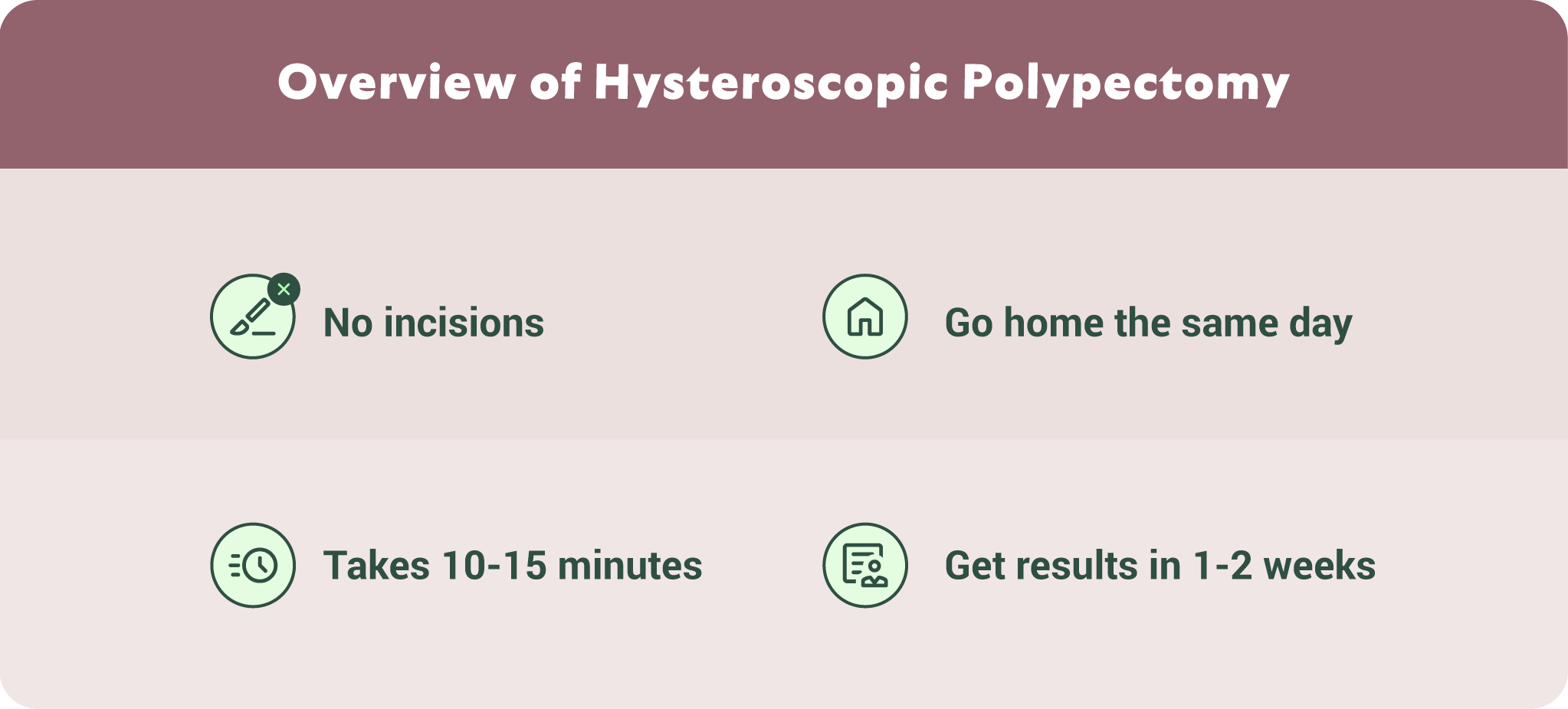
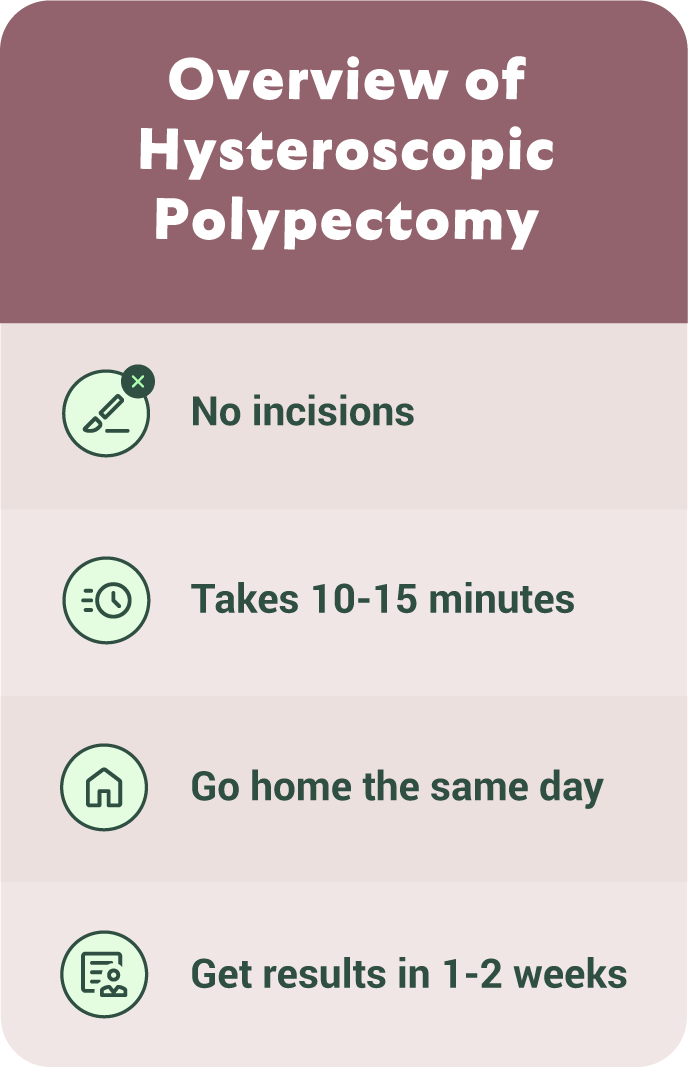
A hysteroscopic polypectomy is a procedure where a small camera (hysteroscope) is inserted through the vagina and cervix to directly view and remove the polyp from the uterus.
Procedure Highlights:
- No abdominal incisions.
- Typically takes 10–15 minutes.
- Tissue is sent to pathology to rule out abnormal cells or cancer.
- You go home the same day—most patients are back to normal activity within 24 hours.
Who Is a Candidate for Hysteroscopic Polypectomy?
You may be a candidate for this procedure if:
- You have abnormal bleeding or spotting.
- Your ultrasound shows a thickened or irregular uterine lining.
- You are undergoing fertility evaluation.
- You need diagnostic clarification (to rule out malignancy or chronic inflammation).
Even patients with minimal or no symptoms may undergo this procedure if their imaging suggests a suspicious mass inside the uterus and they are having trouble getting pregnant or their doctor is concerned about possible malignancy.
How Hysteroscopic Polypectomy Is Performed: Step by Step
Preparing for the Procedure
Before a hysteroscopic polypectomy, your provider may recommend a pelvic ultrasound, with or without saline infusion (sonohysterogram), to visualize the uterus. Your doctor will instruct you on any medications that you should take (or stop taking) before the surgery, as well as any other recommended preparation.
During the Procedure
- Sedation: You’ll be given light or general anesthesia via IV.
- Hysteroscopy: A small camera is inserted into the uterus.
- Polyp removal: Tiny instruments attached to the hysteroscope are used to remove the growth.
This method is preferred over a “blind” dilation and curettage (D&C), which is performed without direct visualization of the uterus via camera. Blind D&Cs may miss the polyp and increase the risk of scarring. Direct visualization ensures the entire polyp is safely and fully removed.
What to Expect After Surgery
- The removed polyp is sent to pathology for microscopic review. Results are typically shared by phone (or, rarely, email) within 1-2 weeks.
- Same-day discharge within hours of the procedure.
- Mild cramping or spotting for several days.
- Pelvic rest (no intercourse, tampons, menstrual cups/discs, swimming, or baths) for 2 weeks.
- No special diet or physical therapy is needed.
- Return to work as soon as the next day.
- No in-office follow-up needed unless symptoms persist.
Risks and Safety Considerations
Hysteroscopic polypectomy is a very safe, low-risk procedure. Rare complications include but are not limited to:
- Fluid overload if too much irrigation fluid enters the bloodstream. (During hysteroscopy, fluid is used to distend the uterus and maximize visualization. At ESSE Care, we closely monitor irrigation fluid to avoid complications.
- Infection or uterine perforation (very rare with experienced surgeons).
- Cramping or light bleeding post-procedure.
Long-Term Outlook and Polyp Recurrence
Most patients experience immediate relief from abnormal bleeding, improved menstrual regularity, and clarity from pathology results. Finding out you have a mass in your uterus can be stressful; a polypectomy (and the associated tissue analysis) brings many patients peace.
Will the Polyp Come Back?
Some patients may develop new polyps after removal, especially those with a personal or family history of polyps or hormonal imbalances. If symptoms return, a repeat ultrasound and hysteroscopy can be considered.
Finding Peace of Mind with Hysteroscopic Polypectomy
Hysteroscopic polypectomy is a quick, effective, and low-risk solution for uterine polyps. It offers patients clarity, symptom relief, and reassurance without the need for major surgery or long downtime.
It’s often the first step in evaluating irregular bleeding or unexplained infertility—and when done well, it can eliminate the need for more invasive procedures.
If you’re experiencing abnormal bleeding or other symptoms and suspect a uterine polyp, schedule a consultation with our team today.