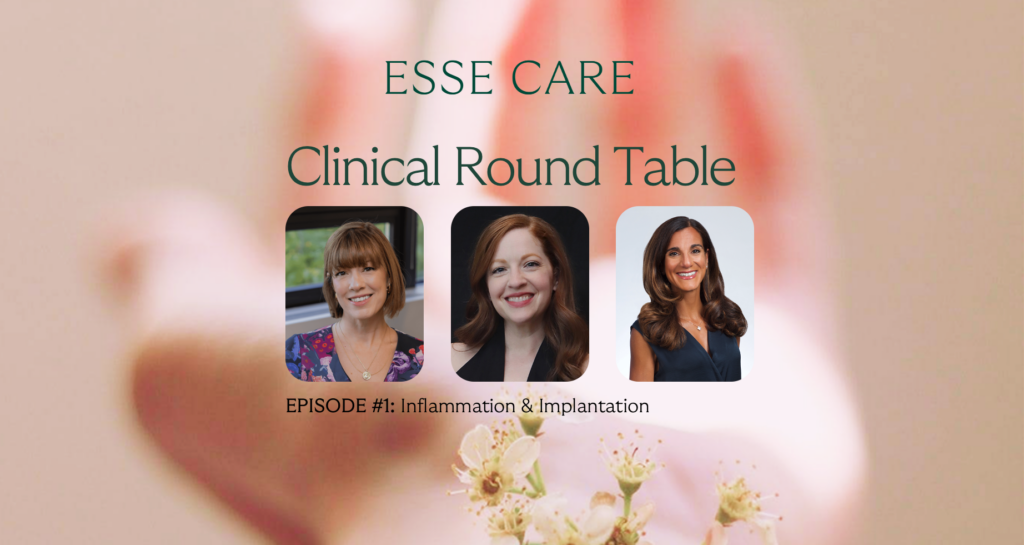
This multidisciplinary conversation brings together perspectives from surgery, reproductive endocrinology, and integrative care to better understand why implantation fails and what is often overlooked in standard fertility treatment.
Why Implantation Failure Isn’t Always About the Embryo
What happens when everything looks “normal,” but implantation still does not occur? In this episode of the Clinical Roundtable, we explore one of the most common and frustrating experiences in fertility care: failed implantation despite strong embryos and reassuring testing. Through real patient cases, this discussion highlights how inflammation, endometriosis, fibroids, and systemic health can influence outcomes.
Rather than focusing only on embryo quality, this conversation shifts the lens toward the environment—what is happening in the uterus, the pelvis, and the body as a whole.
This Clinical Discussion Features:
Dr. Karli Provost Goldstein, DO, FACOG: Founder of ESSE Care and board-certified minimally invasive gynecologic surgeon, Dr. Goldstein shares how conditions like endometriosis and fibroids are often missed on imaging, and why surgical evaluation can play a critical role in uncovering the root cause of implantation failure.
Dr. Sheeva Talebian, MD: Reproductive endocrinologist in New York, Dr. Talebian offers insight into how embryo quality and uterine environment intersect, and why repeated failure with euploid embryos should prompt a shift in clinical approach.
Dr. Mary Sabo, DACM: Doctor of acupuncture and Chinese medicine, Dr. Sabo discusses the role of inflammation, gut health, and the nervous system in fertility, and how integrative therapies can support the body before and after treatment.
What You’ll Learn:
- Implantation Is More Than the Embryo: Why embryo quality alone does not determine success, and how the uterine and systemic environment play a critical role.
- When “Normal” Isn’t the Full Picture: How conditions like endometriosis and fibroids can be missed on imaging but still significantly impact outcomes.
- Recurrent Failure as a Clinical Signal: Why multiple failed transfers or miscarriages are not random, and how they should guide further evaluation.
- The Role of Inflammation Across Systems: How pelvic, immune, and gut-related inflammation can influence egg quality, embryo development, and implantation.
- A More Complete Approach to Care: How combining surgical expertise, fertility treatment, and integrative support can lead to more meaningful and lasting outcomes.
This Conversation Is for You If…
You have been told everything looks normal, but you are not seeing the results you expected.
It may resonate if you have experienced failed embryo transfers, recurrent pregnancy loss, or a diagnosis of unexplained infertility without clear next steps.
This discussion is also for you if you are trying to understand whether there may be something more contributing to your fertility journey, and what it looks like to approach care from a more comprehensive perspective.
A Different Way to Think About Fertility Care
Many patients move through treatment cycles focused on doing “the next step,” without always having the opportunity to step back and reassess whether the standard path makes sense for them.
What this conversation highlights is that when outcomes do not align with expectations, there is often more to uncover. Looking beyond the embryo and evaluating the full environment can change the direction of care in a meaningful way. Fertility is not one-dimensional. And your care shouldn’t be either.
If you have been navigating your fertility journey without clear answers, you are not alone. Your experience is valid, and it deserves a thoughtful, thorough approach. Sometimes, the next step is not doing more of the same but looking at the situation in a different way, with a team that considers the full picture.
No time to watch the video? Read our takeaways from the round table here.