• Let's Chat
  • Contact Form
× Send

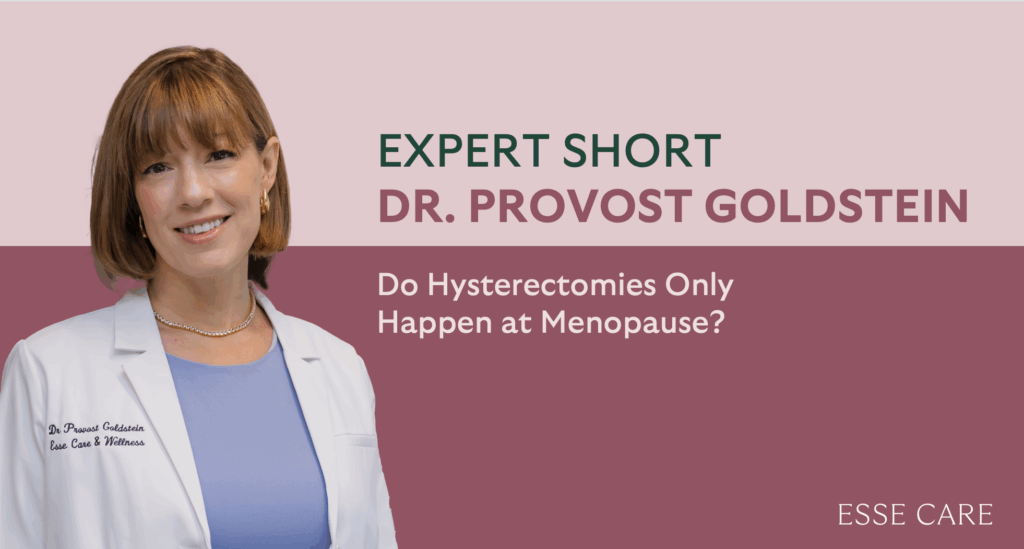
Do Hysterectomies Only Happen at Menopause?

Hysterectomies can be performed at various ages—not just at menopause. Dr. Karli Goldstein explains when and why patients may consider this procedure, including for conditions like endometriosis, adenomyosis, fibroids, or early uterine cancer.

Dr. Karli Provost Goldstein, DO, FACOG explains that hysterectomies are not limited to menopause. While they often occur in the 40s and 50s, many patients undergo this surgery earlier for valid medical reasons—including cancer risk, complex gynecologic conditions, or personal reproductive goals.

Hysterectomies are most commonly performed during the menopausal transition, but they are not age‑restricted. Patients in their 30s or even younger may choose hysterectomy if symptoms are severe and childbearing is complete or not desired.

Clinical indications include early‑stage uterine cancer, complex endometrial hyperplasia, and advanced conditions such as adenomyosisstage 4 endometriosis, and severe fibroids that are unresponsive to conservative treatments.

Every case is different, and the choice to pursue hysterectomy should be made thoughtfully with a trusted minimally invasive gynecologic surgeon who understands your goals and history.

At ESSE Care, we work closely with patients facing complex gynecologic decisions—offering thoughtful, expert guidance for those considering hysterectomy due to cancer risk, fibroids, adenomyosis, or endometriosis. If you’re navigating whether this path is right for you, we welcome you to schedule a consultation with our compassionate, multidisciplinary team.
Content Page Subscribe Widget
Share this post:

Explore more:

What Is a Salpingectomy and What Should You Know Before Having One
Dr. Leigh Rosen explains what a salpingectomy is, why it may be recommended, and why removing your fallopian tubes does not affect your hormones or put you into menopause.
Read More
What Is Chronic Pelvic Pain and Why Early Treatment Matters
Dr. Amanda Chu explains chronic pelvic pain, its most common causes including endometriosis, fibroids, and adenomyosis, and why early treatment is key to preventing lasting neurologic changes.
Read More
Retained Pregnancy Tissue Is More Common Than Many People Realize
How Does Hysteroscopy Help Treat Retained Pregnancy Tissue?
Retained pregnancy tissue is more common than many people realize. It happens when pregnancy tissue does not fully pass after a miscarriage, pregnancy loss, or delivery.
Read More
What Is a Salpingectomy and What Should You Know Before Having One
Dr. Leigh Rosen explains what a salpingectomy is, why it may be recommended, and why removing your fallopian tubes does not affect your hormones or put you into menopause.
Read More
What Is Chronic Pelvic Pain and Why Early Treatment Matters
Dr. Amanda Chu explains chronic pelvic pain, its most common causes including endometriosis, fibroids, and adenomyosis, and why early treatment is key to preventing lasting neurologic changes.
Read More
What Is a Salpingectomy and What Should You Know Before Having One
Dr. Leigh Rosen explains what a salpingectomy is, why it may be recommended, and why removing your fallopian tubes does not affect your hormones or put you into menopause.
Read More
What Is Chronic Pelvic Pain and Why Early Treatment Matters
Dr. Amanda Chu explains chronic pelvic pain, its most common causes including endometriosis, fibroids, and adenomyosis, and why early treatment is key to preventing lasting neurologic changes.
Read More
Retained Pregnancy Tissue Is More Common Than Many People Realize
How Does Hysteroscopy Help Treat Retained Pregnancy Tissue?
Retained pregnancy tissue is more common than many people realize. It happens when pregnancy tissue does not fully pass after a miscarriage, pregnancy loss, or delivery.
Read More