Do you ever feel sharp chest pain, a heaviness when you breathe, or unexplained shortness of breath around your period? Have you experienced a spontaneous lung collapse with no clear explanation?
Despite what other doctors may have told you, these may be signs of advanced endometriosis.
Chest pain during menstruation isn’t common and it’s never something to brush off. While panic isn’t the answer, neither is ignoring your body’s signals. Many patients are told their symptoms are “just anxiety” when in fact, their body is sounding a very real alarm. Trust that instinct.
Is It Normal to Have Chest Pain During Your Period?


Everyone gets chest pain from time to time, and it may not have a serious underlying cause. But if you notice a pattern of recurring chest pain or other respiratory symptoms during or leading up to menstruation each month, it’s worth investigating—especially if you already have an endometriosis diagnosis.
The following symptoms during or a few days prior to your period could be related to endometriosis:
- Pain or tightness in the right side of your chest (can feel sharp, stabbing, or like an elephant sitting on your chest)
- Pain in the right shoulder
- Pain in the right upper abdomen
- Crackling or bubbling sensation, often worse with breathing
- Shortness of breath with activities like walking or climbing stairs
- Lung collapse (pneumothorax)
- Coughing up blood (hemoptysis)
- Blood collecting around the lungs (hemothorax)
- Fatigue
- Infertility
These symptoms can be subtle. A patient can have endometriosis throughout her thoracic cavity and even experience a lung collapse and still only feel slight unexplained shortness of breath.
On the other hand, some patients may have severe pain that sends them to the ER. In these cases, ER doctors may investigate heart-related issues only to send the patient home with a clean bill of health and a diagnosis of “anxiety.”
Remember: You know your body best. If cardiovascular causes have been eliminated and you’re still experiencing respiratory symptoms during your period, it’s time to visit an endometriosis specialist for a more thorough investigation.
Why Is This Happening? How Does Endometriosis Cause Chest Pain?


As we often remind our patients and the wider healthcare community, endometriosis is a whole-body disease. Although endometriosis most commonly involves the pelvic organs, like the uterus and ovaries, in rare cases it can spread to distant locations, such as the lungs and diaphragm.
We call these cases thoracic endometriosis. Endo lesions in these areas can create holes that allow the disease to infiltrate the lung cavity. Most patients won’t experience a lung collapse, but they may feel respiratory symptoms if endometriosis affects the diaphragm.
These cases fall under a category called Thoracic Endometriosis Syndrome (TES).
Here’s how it happens:
- Endometriosis implants on the diaphragm or chest wall.
- Lesions bleed or swell in response to the menstrual cycle.
- This may irritate the phrenic nerve, which travels from the neck down to the diaphragm.
- Blood or air may enter the pleural space, leading to lung collapse (pneumothorax) or blood around the lung (hemothorax).
While lung collapse is rare, even small lesions on the diaphragm can cause significant discomfort, referred pain, and breathing difficulties. Many patients with thoracic disease also have undiagnosed pelvic endometriosis, which makes the picture even more complex.
When to See a Doctor for Chest Pain During Your Period
The short answer: It’s always best to see a doctor for severe, recurring, or new chest pain to ensure what you’re experiencing isn’t an emergency.
If you’ve experienced any of the following, it’s time to see a specialist:
- Recurring chest or shoulder pain tied to your cycle
- Shortness of breath that worsens during menstruation
- Diagnosed lung collapse without a clear cause
- Fatigue or weakness that flares predictably with your period
- A history of being told “it’s anxiety” without further workup
Just because an emergency room or urgent care center told you nothing is wrong with your heart or lungs doesn’t mean you should ignore what you’re feeling. Few doctors are trained to spot the signs of endometriosis, and the disease can hide in tricky places, making it difficult or even impossible to see on common scans like chest X-rays, CT scans, and MRIs.
Misdiagnoses are common. Seeing a provider who knows the right questions to ask can make all the difference.
How Thoracic Endometriosis Is Diagnosed and Treated
If your doctor suspects that endometriosis could be causing your chest pain and other respiratory symptoms, they will likely start the investigation with CT scans or MRIs. As we mentioned above, endometriosis may not show up on imaging, but it’s the easiest and least invasive way to begin looking for the signs.
Tools that may be useful or used for diagnosis:
- Symptom diary to track timing and patterns
- CT scans or MRIs (though often inconclusive)
- Pelvic imaging, if coexisting disease is suspected
- Referral to a thoracic or minimally invasive gynecologic surgeon (MIGS) if suspicion is high
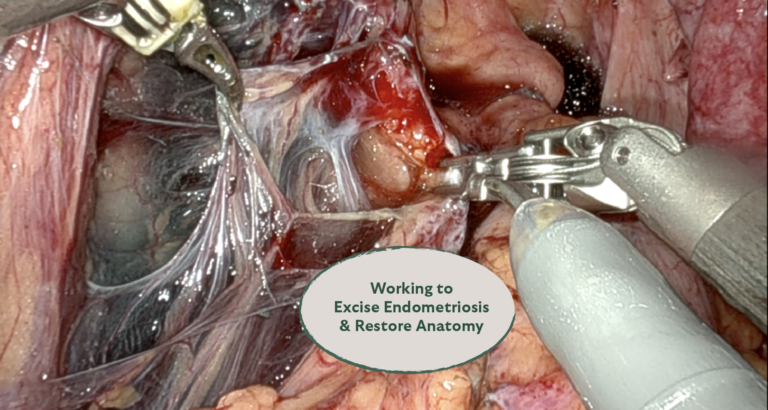
The only way to truly diagnose and treat endometriosis is with surgery. Typically, this can be done laparoscopically through small incisions in the abdomen, but cases of thoracic endometriosis may also require incisions between the ribs (thoracoscopy) in order to visualize and treat all diseased areas. Once the surgeons locate the affected organs and tissues, they can work to remove all lesions, cysts, and adhesions (scar tissue) to restore the body to proper function.
Both procedures are minimally invasive and allow for diagnosis and excision in the same operation when coordinated by experienced multidisciplinary teams.
What You Can Do Right Now
If you’ve read this far and feel like we’re describing your experience, here are next steps you can take right away:
Advocate for yourself:
- Track symptoms by day of cycle.
- Note any ER visits, imaging, or previous misdiagnoses.
- Ask your provider directly: “Could this be thoracic endometriosis?”
While waiting for specialist care:
- Avoid intense activity if you’ve had lung collapses.
- Try gentle breathwork or positioning changes (like lying on your side) to ease discomfort.
- Support your system with anti-inflammatory nutrition or stress-relief tools, knowing this won’t treat the cause, but can provide comfort.
You might also consider requesting a second opinion if your symptoms continue to be dismissed.
Our team at ESSE is built for exactly this kind of complexity. We don’t just treat symptoms—we look at the pattern, the history, and the whole patient.
If you’ve been told your chest pain is in your head, we want to be the place where you’re heard, seen, and believed.
We partner with cardiothoracic and minimally invasive gynecologic surgeons, and we’ve walked this road with many patients who felt like they had run out of options. You deserve that same level of care and clarity.
Find the Root Cause of Your Menstrual Chest Pain
At ESSE Care, we’re ready to listen to your story. We won’t dismiss your symptoms as anxiety or costochondritis; we believe you when you say you know something bigger is going on.
If you’ve had unsuccessful chest surgeries or suspect your symptoms have been overlooked, we’re happy to review your case and connect you with our multi-specialty team, which includes expert cardiothoracic surgeons specializing in extensive endometriosis.
Don’t wait. Contact our team today to schedule a consultation.