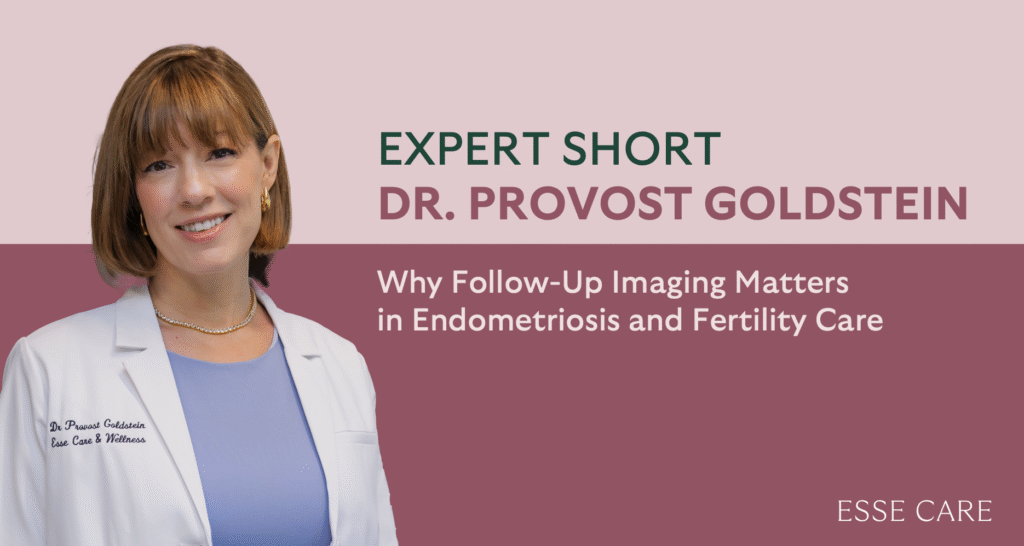
Why Follow-Up Imaging Matters in Endometriosis and Fertility Care
Dr. Karli Provost Goldstein recently shared a PSA after seeing a fertility patient whose case raised serious concern. This is a reminder to both patients and providers: follow-up imaging is not a luxury. It is a critical part of safe, comprehensive care.
This patient had surgery last fall to remove an endometrioma. But there was no full excision. No ongoing evaluation. No imaging to assess the underlying disease.
By the time she came to ESSE Care, she was dealing with all of the following: persistent bilateral hydronephrosis (swelling of both kidneys due to urine backup), a collapsed lung, a mass on the liver, and a hole in the diaphragm — a possible sign of thoracic endometriosis. And despite all this, she had recently undergone another embryo transfer. Her team had continued fertility treatments without understanding the full extent of her disease.
This is not safe. Hydronephrosis is not a minor complication. It can cause long-term kidney damage and may reflect deep or multi-organ endometriosis that requires surgical care. When these symptoms go unmonitored, outcomes suffer.
We recommend yearly follow-ups with imaging, especially if you have a history of endometriosis. Learn about our comprehensive monitoring approach.
Learn MoreWhen Imaging Becomes Critical
If you have had partial surgery or are continuing fertility treatments without clear follow-up, ask your team about imaging. Ask what is being watched. Ask what is being missed. It could change everything.
Many patients don’t realize that adhesions often hide from standard imaging like MRIs and ultrasounds. Getting specialized imaging at the right facilities can make all the difference in detecting endometriosis effectively.
Expert guidance on when to pursue excision surgery before IVF and how to sequence fertility treatments for the best outcomes.
Watch WebinarAt ESSE Care, we take a whole-person approach. We follow our patients closely. We use imaging to guide safe decisions, especially in fertility-focused care. And we believe every patient deserves that level of attention.
Continuing fertility treatments without understanding the full scope of endometriosis can compromise both safety and success rates. Comprehensive evaluation should come first. Understanding when to pursue excision surgery before IVF can make a significant difference in outcomes.
Advanced endometriosis doesn’t stay confined to the pelvis. When disease involves multiple organ systems, specialized monitoring and coordinated care become essential. Many doctors miss symptoms that extend beyond pelvic pain, including digestive, urinary, and respiratory complications that may indicate advanced disease with distant organ involvement.
If you’ve been told “everything looks fine” on imaging but continue to have symptoms, or if you’re pursuing fertility treatments without comprehensive endometriosis evaluation, it’s time to ask harder questions. Learn when to see an endometriosis specialist and how to advocate for comprehensive evaluation, especially with multi-organ symptoms.
Connect with Dr. Goldstein’s team for comprehensive evaluation and monitoring of complex endometriosis symptoms.
Get Started