• Let's Chat
  • Contact Form
× Send

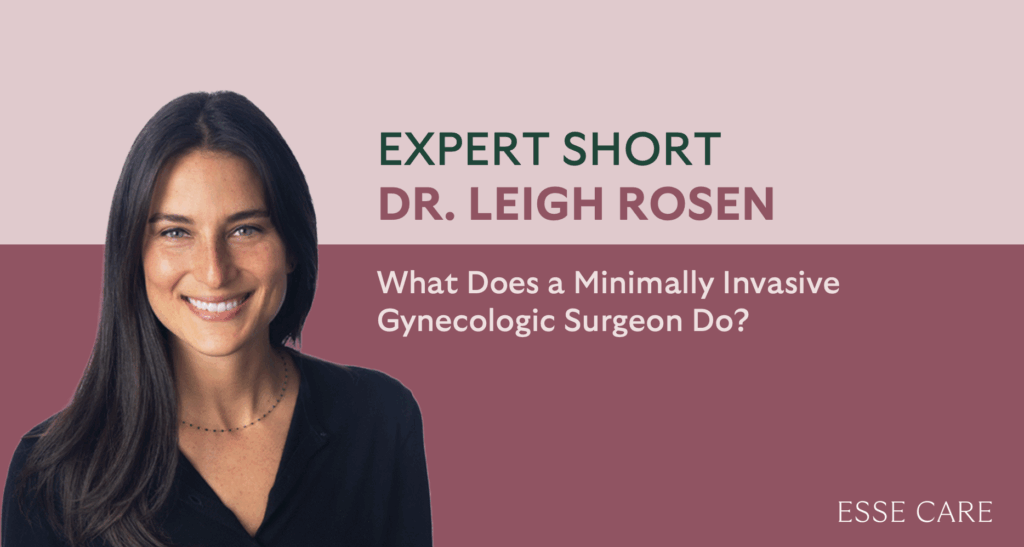
What Does a Minimally Invasive Gynecologic Surgeon Do?

From fibroids to uterine scar tissue, Dr. Leigh Rosen shares how she collaborates with fertility specialists and provides expert surgical care to restore function and comfort.

What Does a Minimally Invasive Gynecologic Surgeon Do?

In this brief introduction, Dr. Leigh Rosen shares what her daily role includes, the conditions she treats, and how she collaborates with other specialists to offer comprehensive care.

“Even some of my friends and family don’t fully understand what I do every day,” Dr. Rosen says. As a minimally invasive gynecologic surgeon, she cares for conditions such as uterine fibroids, uterine septums & cavity abnormalities (advanced hysteroscopy), uterine scar tissue (Asherman’s syndrome), polyps, and ovarian cysts.

Patients often see her to gain clarity on their diagnosis and explore surgical options. She collaborates closely with general OB/GYNs and reproductive endocrinology / infertility teams who refer cases needing surgical evaluation.

Her weekly schedule is a mix: three days dedicated to advanced minimally invasive procedures in the operating room, and two days in clinic reviewing images, assessing symptoms, and planning patient-specific care.

“I hope this gives you a clearer picture of my work,” Dr. Rosen adds. With both surgical expertise and empathy, she shows up for patients navigating reproductive health challenges.
Precision, Compassion & Reproductive Support

At ESSE Care, minimally invasive surgery is grounded not just in technique, but in restoring function, preserving fertility, and centering your whole-person journey.

If you’re facing unexplained symptoms or fertility concerns, you don’t have to walk this path alone. Contact us to learn more about care with Dr. Leigh Rosen.

Content Page Subscribe Widget
Share this post:

Explore more:

Inflammation and Implantation_Clinical Round Table
Clinical Round Table Ep. 1 On-Demand: Inflammation and Implantation
What happens when everything looks “normal,” but implantation still does not occur? We explore one of the most common and frustrating experiences in fertility care: failed implantation despite strong embryos...
Read More
What Is a Salpingectomy and What Should You Know Before Having One
Dr. Leigh Rosen explains what a salpingectomy is, why it may be recommended, and why removing your fallopian tubes does not affect your hormones or put you into menopause.
Read More
What Is Chronic Pelvic Pain and Why Early Treatment Matters
Dr. Amanda Chu explains chronic pelvic pain, its most common causes including endometriosis, fibroids, and adenomyosis, and why early treatment is key to preventing lasting neurologic changes.
Read More
Inflammation and Implantation_Clinical Round Table
Clinical Round Table Ep. 1 On-Demand: Inflammation and Implantation
What happens when everything looks “normal,” but implantation still does not occur? We explore one of the most common and frustrating experiences in fertility care: failed implantation despite strong embryos...
Read More
What Is a Salpingectomy and What Should You Know Before Having One
Dr. Leigh Rosen explains what a salpingectomy is, why it may be recommended, and why removing your fallopian tubes does not affect your hormones or put you into menopause.
Read More
Inflammation and Implantation_Clinical Round Table
Clinical Round Table Ep. 1 On-Demand: Inflammation and Implantation
What happens when everything looks “normal,” but implantation still does not occur? We explore one of the most common and frustrating experiences in fertility care: failed implantation despite strong embryos...
Read More
What Is a Salpingectomy and What Should You Know Before Having One
Dr. Leigh Rosen explains what a salpingectomy is, why it may be recommended, and why removing your fallopian tubes does not affect your hormones or put you into menopause.
Read More
What Is Chronic Pelvic Pain and Why Early Treatment Matters
Dr. Amanda Chu explains chronic pelvic pain, its most common causes including endometriosis, fibroids, and adenomyosis, and why early treatment is key to preventing lasting neurologic changes.
Read More